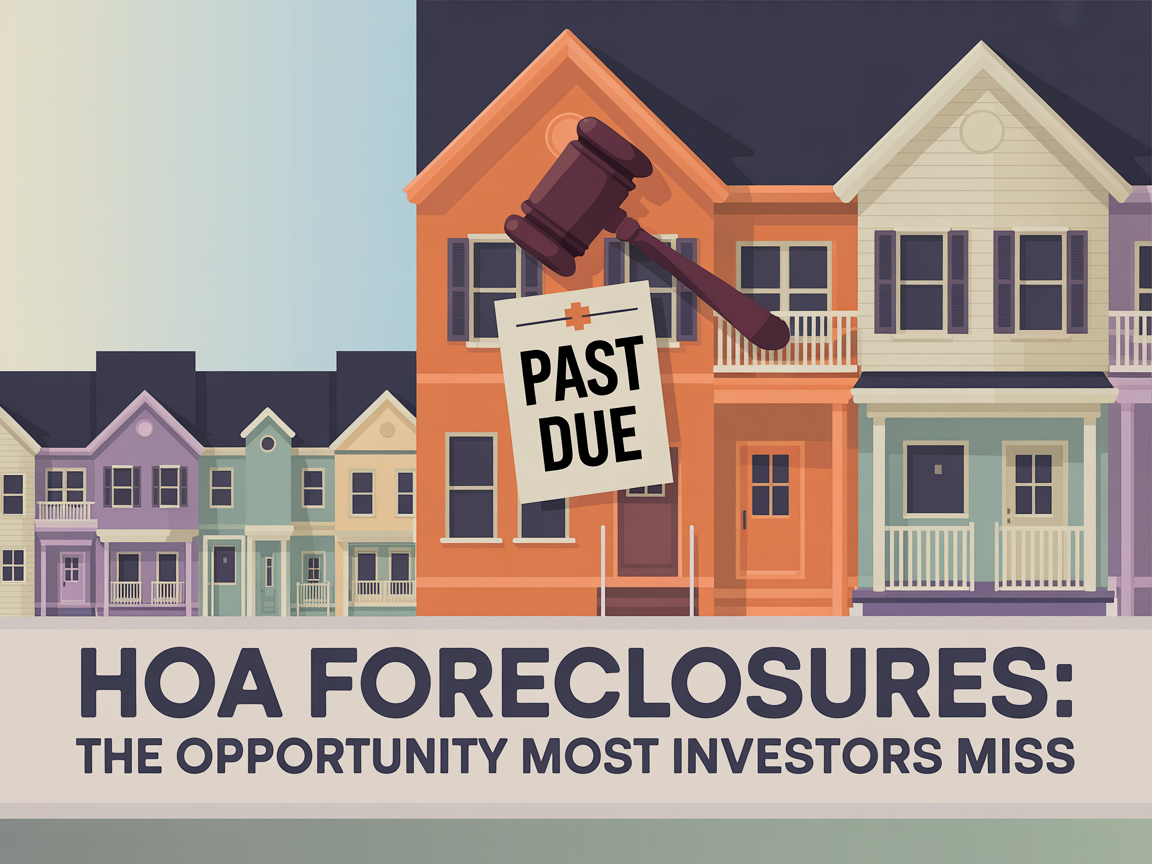
HOA foreclosures florida investors monitor represent one of the most overlooked opportunities in the state, because association-driven sales frequently generate properties with significant equity at prices that reflect only unpaid dues rather than true market value.
HOA foreclosures in Florida represent one of the most overlooked investor opportunities in the state, because association-driven sales frequently generate properties with significant equity at prices that reflect only the unpaid dues rather than the true market value of the asset.
Most real estate investors in Florida are familiar with the two primary auction channels: mortgage foreclosures and tax deed sales. These are the headliners of the off-market investing world, the ones discussed in every podcast, every seminar, and every beginner’s guide. But there is a third category of auction that flies under the radar for most investors, one that can produce exceptional deals precisely because so few people are paying attention to it. That category is HOA foreclosures.
An HOA foreclosure happens when a homeowners association or condominium association forecloses on a property because the owner failed to pay their required assessments, dues, or fees. Under Florida law, associations have the legal authority to place a lien on a property for unpaid amounts and, if those amounts remain unpaid, to pursue foreclosure through the court system. The property is then sold at auction, often for a fraction of its market value.
What makes HOA foreclosures particularly interesting for investors is the unique combination of opportunity and complexity they present. The opportunity comes from the fact that these auctions draw far less competition than traditional foreclosure or tax deed sales. The complexity comes from the fact that, unlike tax deed sales, an HOA foreclosure does not wipe out the existing mortgage. That surviving mortgage is the single most important factor an investor must understand before bidding on any HOA foreclosure, and it is the factor that keeps most casual investors away. For those who understand how to navigate it, though, the lack of competition can translate into remarkable deals.
Why HOA Foreclosures Are Everywhere in Florida
Florida is the epicenter of HOA-governed living in the United States. According to data compiled by iPropertyManagement, Florida has approximately 50,100 homeowners associations, the second-highest count of any state after California. But in terms of the percentage of homes governed by an HOA, Florida leads the nation. Roughly 45% of Florida’s 8.6 million homes belong to an HOA, according to the South Florida Agent Magazine. That amounts to approximately 3.9 million homes, with an average monthly HOA fee of $389. Nationally, about 82% of newly built homes sold in 2023 were part of HOA communities, and in Florida, where master-planned developments dominate new construction, that figure is even higher.
The sheer number of HOA-governed properties creates a proportionally large pool of potential delinquencies. When homeowners fall behind on their mortgage, they often fall behind on their HOA dues as well. But HOA delinquencies can also happen independently of mortgage trouble. A homeowner might be current on their mortgage but unable or unwilling to keep up with rising HOA assessments, special assessments for major repairs (like roof replacements or building re-certifications in the wake of the Surfside condo collapse), or escalating insurance costs that HOAs pass through to their members.
Florida’s insurance crisis has made this worse. As property insurance premiums have surged across the state, many HOAs and condo associations have seen their master insurance policies double or triple in cost over the past few years. Those increases get passed directly to unit owners through higher assessments. For owners who are already stretched thin by their mortgage, property taxes, and personal insurance, a sudden spike in HOA fees can be the breaking point. When owners stop paying, the association’s options are limited: they can absorb the shortfall (which raises costs for everyone else), or they can pursue collection and, eventually, foreclosure.
The result is a growing inventory of HOA foreclosure actions across the state, particularly in condo-heavy markets like Miami-Dade, Broward, Palm Beach, and the Tampa Bay corridor. These actions do not always make it to auction (many are resolved through payment plans or settlements before they reach that stage), but those that do can represent significant opportunities for investors who know what they are looking at.
How the HOA Foreclosure Process Works in Florida
The legal process for an HOA foreclosure in Florida is governed by Chapter 720 of the Florida Statutes for homeowners associations and Chapter 718 for condominium associations. While the two sets of statutes have some differences in timelines and notice requirements, the overall process is similar. Both require the association to foreclose judicially, meaning they must file a lawsuit in circuit court, just like a mortgage lender would.
The process begins when a homeowner falls behind on assessments. The association must first send a written demand by certified mail and first-class mail, giving the homeowner 45 days to pay all amounts due. This notice requirement is strictly enforced. If the association fails to follow the proper notice procedures, the entire lien and foreclosure can be challenged and potentially thrown out by a court. According to attorneys at Nolo.com who specialize in Florida foreclosure law, procedural compliance is one of the most commonly litigated aspects of HOA foreclosure cases.
If the homeowner does not pay within the 45-day window, the association can record a claim of lien against the property in the county’s official records. This lien secures the debt and serves as the legal basis for any future foreclosure action. Once the lien is recorded, the association must provide an additional 45 days’ notice of its intent to foreclose before actually filing the lawsuit. The Homeowners Protection Bureau notes that for HOA liens, the statute of limitations for filing a foreclosure action is five years from the date the lien was recorded. For condo association liens, the window is much shorter at just one year.
Once the lawsuit is filed, the case proceeds through the court system like any other foreclosure. The homeowner can raise defenses, negotiate a settlement, or file a “qualifying offer” to pay the full amount owed within 60 days. If the homeowner does not respond or the court rules in favor of the association, a foreclosure judgment is entered and the property is scheduled for auction. The auction is conducted by the Clerk of the Circuit Court, and the property is sold to the highest bidder.
Here is where it gets interesting for investors. The amounts owed to an HOA are typically much smaller than the amounts owed on a mortgage. It is not uncommon for an HOA to foreclose over $5,000 to $20,000 in unpaid dues, legal fees, and interest. This means the opening bid at an HOA foreclosure auction is often a tiny fraction of the property’s market value. In some cases, if no third-party bidder shows up, the association itself takes title to the property for the amount of its lien, sometimes for as little as a few thousand dollars.
The Surviving Mortgage: Understanding the Biggest Risk
This is the part that separates HOA foreclosures from every other type of real estate auction, and it is the part that every investor must understand completely before placing a bid. When an HOA forecloses on a property, the existing mortgage is not wiped out. The mortgage survives the sale.
This is fundamentally different from a tax deed sale, where most private liens (including mortgages) are extinguished. In an HOA foreclosure, the association’s lien is typically junior to the first mortgage. Under Florida law, the priority of liens is generally determined by recording date: whichever lien was recorded first has priority. Since the mortgage is almost always recorded before any HOA lien, the mortgage holds a senior position. When the junior lien (the HOA lien) is foreclosed, the senior lien (the mortgage) remains attached to the property.
What does this mean in practice? It means that if you buy a property at an HOA foreclosure auction, you are buying it subject to the existing mortgage. The mortgage lender still has the right to foreclose on that mortgage if the debt is not satisfied. So if the property has a $200,000 mortgage balance and you purchase it at an HOA auction for $10,000, you now own the property but you also owe (or are subject to) that $200,000 mortgage. If the lender decides to foreclose, your ownership could be wiped out.
This is why due diligence on HOA foreclosures is absolutely critical. You need to know the exact balance of the surviving mortgage, whether the mortgage is in default, and what the lender’s likely course of action will be. In some cases, the mortgage lender has already initiated its own foreclosure, and the HOA foreclosure is happening in parallel. In other cases, the lender may be slow to act, particularly if the property is underwater (worth less than the mortgage balance). There are also situations where the mortgage has been paid off or is very small, making the HOA foreclosure a much simpler and more profitable deal.
Experienced HOA foreclosure investors develop strategies for each scenario. Some focus exclusively on properties where the mortgage balance is low relative to market value, so acquiring the property subject to the mortgage still makes financial sense. Others look for properties where the mortgage lender has been inactive for an extended period and may be willing to accept a short payoff. And some investors purchase at HOA auctions with the understanding that they will rent out the property and collect income during the period before any potential mortgage foreclosure, treating the investment as a calculated, time-limited play.
Where the Real Opportunities Hide
Despite the mortgage risk, there are several scenarios where HOA foreclosures can be enormously profitable. The first and most straightforward is when the existing mortgage has been satisfied. This happens more often than many investors realize. Some properties, especially older condos in markets where values have not appreciated dramatically, have fully paid-off mortgages. The owner may have stopped paying HOA dues due to financial hardship, relocation, or simply abandoning the unit. In these cases, the HOA foreclosure gives you a property with no mortgage at all, purchased for the cost of the delinquent assessments plus legal fees.
The second opportunity arises when the mortgage balance is very low. If a homeowner purchased a condo 15 or 20 years ago and has been paying down the mortgage steadily, the remaining balance might be $30,000 or $40,000 on a property worth $150,000 or more. Buying at the HOA auction and then paying off the remaining mortgage can still result in acquiring the property at a deep discount to market value.
The third scenario, and the one that requires the most sophistication, involves properties where the mortgage lender has been largely inactive. Some mortgage holders, particularly those managing large portfolios of underperforming loans, take years to initiate foreclosure proceedings. During that time, an investor who acquires the property through an HOA foreclosure can take possession, bring the unit up to rental standards, and generate cash flow. The key risk is that the mortgage lender could eventually foreclose, but many investors build this risk into their underwriting by ensuring they recoup their investment through rental income within a specific timeframe.
Finally, there is an opportunity in the negotiation itself. Once you own a property purchased at an HOA foreclosure (subject to the mortgage), you are in a position to contact the mortgage lender and negotiate. Lenders often prefer to work with an active, engaged owner rather than pursue a lengthy and expensive foreclosure. You may be able to negotiate a loan modification, a short payoff, or even an assumption of the existing mortgage at favorable terms. This requires negotiation skill and persistence, but it can turn a complicated deal into a very profitable one.
Due Diligence for HOA Foreclosure Auctions
The research process for an HOA foreclosure is similar to other auction types but with some important additions. The standard steps still apply: search the title, verify the legal description, assess the property’s condition, and determine market value through comparable sales analysis. But with HOA foreclosures, you also need to dig into the specific financial situation of both the property and the association.
Start with the title search. This is non-negotiable. A thorough title search will reveal the existing mortgage (or mortgages), any other liens on the property, and the recording dates that determine lien priority. It will also show whether there are any other pending foreclosure actions on the same property. It is not unusual for an HOA foreclosure and a mortgage foreclosure to be proceeding simultaneously on the same unit. You need to know where both cases stand before deciding whether to bid. A title ownership change monitoring service can also alert you when a property you’re watching changes hands, helping you track auction outcomes and identify properties that may be re-entering distressed status.
Next, research the mortgage. Determine the approximate remaining balance, the identity of the current mortgage servicer, and whether the mortgage is in default. You can often find this information through public records (lis pendens filings indicate a pending foreclosure), the county Property Appraiser’s records (which sometimes show the original mortgage amount and date), and by reviewing the court docket for any related cases. The goal is to build a complete picture of the financial obligations attached to the property before you bid.
You should also research the association itself. A condo or HOA that is financially unstable, has a high delinquency rate, or is facing major capital expenses (like building re-certification requirements under Florida’s newer condo safety laws) can present additional risks even if the individual deal looks attractive. Review the association’s budget, reserve fund status, and any pending or recent special assessments. This information is sometimes available through the association’s management company or through public records requests.
Tools like PropertyOnion.com can streamline much of this research by aggregating auction data and property information into a single platform, allowing you to identify upcoming HOA foreclosure auctions alongside traditional foreclosure and tax deed sales. Having all three channels visible in one place makes it much easier to compare opportunities and allocate your research time efficiently.
The Bottom Line on HOA Foreclosures
HOA foreclosures are not for every investor. They require a deeper level of due diligence than tax deed sales, a more nuanced understanding of lien priority than traditional foreclosures, and a willingness to navigate complex post-purchase situations that can include mortgage negotiations, tenant occupancy issues, and association politics. The learning curve is steeper, and the margin for error is thinner.
But that complexity is exactly what creates the opportunity. Because most investors do not take the time to understand HOA foreclosures, competition at these auctions is significantly lower. Properties that might attract dozens of bidders at a traditional foreclosure auction may draw only a handful of interested parties at an HOA sale. This reduced competition translates directly into lower purchase prices and wider profit margins for the investors who are prepared.
For newer investors, the best approach is to start by observing. Attend a few HOA foreclosure auctions in your target market without bidding. Study the properties that sell, the prices they sell for, and the situations of the underlying mortgages. Talk to attorneys and title companies that specialize in this area. Build your understanding before you commit capital.
For experienced investors looking to expand their deal flow, HOA foreclosures represent a genuinely underserved channel. In a state where nearly half of all homes belong to an HOA, and where financial pressures on homeowners continue to mount from insurance costs, special assessments, and rising fees, the pipeline of HOA foreclosure opportunities is only growing. The question is not whether these deals are worth pursuing. The question is whether you are willing to do the homework required to pursue them safely.
HOA foreclosure sales differ fundamentally from standard florida foreclosure auctions because the first mortgage typically survives the HOA sale intact, which means bidders must factor the existing mortgage balance into their total acquisition cost calculation.
Before bidding at any HOA foreclosure, conduct a thorough florida title search to determine the exact balance of any surviving first mortgage, since this is the single most important factor in evaluating whether an HOA foreclosure deal has enough margin to be profitable.
Properties acquired through HOA foreclosures often have tenants or former owners in residence. Understanding the foreclosure eviction process helps investors plan for the time and cost of resolving any occupancy situation after the auction sale is complete.
After acquiring an HOA foreclosure property, some investors need to file a quiet title action florida to resolve competing claims and establish clear, insurable title before the property can be resold or refinanced successfully.
Understanding the broader landscape of florida foreclosure laws gives HOA foreclosure investors the legal context they need to evaluate each deal correctly and understand what rights and obligations transfer with the auction purchase.
Ready to Find Your Next Florida Foreclosure Deal?
Florida foreclosure and tax deed auctions move fast. PropertyOnion.com keeps you ahead with complete county coverage, research tools, and step-by-step eBook guides you can download and use immediately on your next deal.
Get My Free Membership Now





This was very helpful and informative. I will definitely look into foreclosure HOA sales.