If you spend any amount of time researching Florida foreclosure properties before they hit the auction block, you will regularly encounter a filing called a lis pendens. For investors who understand what it means and how to use it, a florida lis pendens is one of the most valuable pieces of public information available. It signals that a legal action has been filed against a property, and for foreclosure auction investors it is often the earliest possible warning that a property is headed toward a forced sale. Learning to read and track florida lis pendens filings is a core research skill for anyone building a serious auction acquisition pipeline.
This article covers what a florida lis pendens actually is under state law, how it differs from other property filings, what it means for investors watching a property, and how to use it as a tool for both early deal identification and pre-bid due diligence.
What a Florida Lis Pendens Means and Why Investors Track It
The term lis pendens is Latin for pending lawsuit. In Florida, a florida lis pendens is a formal written notice recorded in the official records of the county where the property is located. It gives constructive notice to anyone who searches the title that a lawsuit is pending which may affect ownership or title to that specific property. Once recorded, anyone who subsequently acquires an interest in the property takes that interest subject to the outcome of the litigation.
For real estate investors, the most significant category of florida lis pendens filings is the mortgage foreclosure action. When a lender files a foreclosure lawsuit in circuit court, they record a lis pendens in the county official records simultaneously with or shortly after filing the complaint. That recording is the investor’s earliest public signal that the property is entering the foreclosure process. Depending on the county and the complexity of the case, a florida lis pendens may appear months or even years before the property reaches the auction block. That lead time is exactly what sophisticated investors use to get ahead of the competition.
How a Florida Lis Pendens Differs From Other Property Filings
A florida lis pendens is not a lien. It does not create a monetary claim against the property the way a judgment lien or mortgage does. It is purely a notice filing. Its legal effect is to put the world on constructive notice that the property is the subject of ongoing litigation. This distinction matters for investors because a lis pendens does not establish lien priority, does not show up in the same way as a recorded judgment, and does not by itself encumber the title.
What it does do is cloud the title in a practical sense. A property with an active florida lis pendens on it cannot be sold with clean title until the pending action is resolved, either by dismissal of the case, settlement, or final judgment. A buyer who purchases a property with knowledge of an active lis pendens takes the property subject to whatever the court ultimately decides. This is why sellers cannot simply sell out from under a foreclosure by transferring the deed to a family member or related entity once a lis pendens has been recorded.
Understanding how a lis pendens interacts with the broader title picture is part of what makes tracking title search mistakes important for auction investors. Investors who skip a proper title search because they have already reviewed the lis pendens may miss other encumbrances that will survive the foreclosure sale.
Using Florida Lis Pendens Filings to Build an Early Pipeline
The real strategic value of a florida lis pendens for investors is not in the filing itself but in what it signals about timing. A foreclosure case in Florida typically takes anywhere from 12 months to several years to reach the auction stage, depending on the complexity of the case, whether the homeowner contests the action, and the backlog in the local circuit court. Investors who begin tracking a property from the lis pendens filing have that entire window to research the property, monitor the case progress, and prepare their bidding strategy long before the auction date is announced.
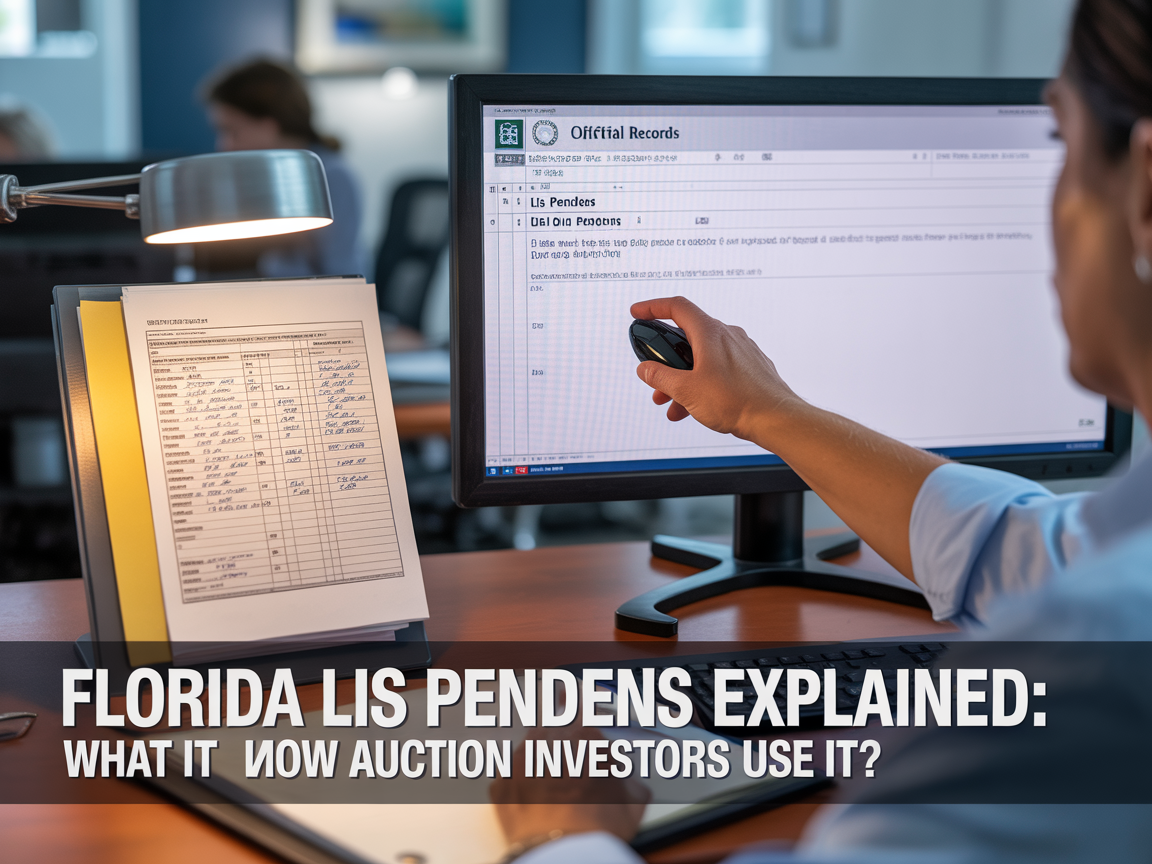
Florida lis pendens filings are recorded in the official records of each county and are publicly searchable. Many county clerk websites allow searches by property address, owner name, or legal description. Third-party data platforms aggregate these filings across counties and send alerts when new foreclosure lis pendens are recorded in your target markets. Building a regular review of new florida lis pendens filings in your counties of interest into your weekly research routine is one of the highest-leverage habits an auction investor can develop.
For investors who understand florida foreclosure auctions well, the lis pendens is also useful for tracking case progress after the initial filing. Once you identify a property you want to track, monitoring the court file for subsequent filings tells you when the case is moving toward a summary judgment hearing, when a final judgment has been entered, and when the auction date is likely to be set. The MyFloridaCounty.com portal and individual county clerk websites provide public access to court filings that let you track this progression without paying for premium data services.
What to Do When You Find a Property With an Active Lis Pendens
When you identify a florida lis pendens on a property that interests you, your next step is to pull the court file for the underlying case. The case number is typically referenced in the lis pendens recording. From the court file you can determine who the plaintiff is, what the basis of the lawsuit is, what amount is claimed, and whether the property owner has filed any response or defense.
For a mortgage foreclosure, the court file will show you the original loan amount, the default amount being claimed, any attorney fees, and whether there are other defendants named in the suit such as junior lienholders, HOA associations, or the IRS. The defendants named in a foreclosure tell you a great deal about the lien stack on the property. A case with an IRS lien as a named defendant signals that there is a federal tax lien on the property that will need to be resolved, either through the foreclosure process or separately after you win the auction.
Pulling the court file also tells you how far along the case is. A case at the lis pendens stage is very different from a case where a final judgment has already been entered and only the auction date is pending. Knowing the stage helps you prioritize which properties need immediate attention and which are still months away from auction. For investors who track the full florida foreclosure timeline, being able to place each property accurately within that timeline is what allows you to manage a research pipeline efficiently across many properties simultaneously.
Lis Pendens and Post-Sale Title Considerations
Once a foreclosure auction concludes and the clerk issues a Certificate of Title, the underlying lis pendens is extinguished along with the foreclosure action. The Certificate of Title replaces it. However, investors should verify that the lis pendens has been properly released in the official records as part of their post-sale title review. Unreleased lis pendens filings from prior actions on the same property can occasionally appear in title searches and create confusion, even when they have been legally resolved.
For tax deed properties, the situation is more nuanced. A florida lis pendens on a tax deed property may relate to a separate lawsuit entirely, such as an ownership dispute or a code enforcement action, not a mortgage foreclosure. In those cases, winning the tax deed at auction does not automatically resolve the pending litigation. The new owner may need to take affirmative legal action to address whatever underlying dispute was the basis of the lis pendens, including potentially pursuing a quiet title action florida to clear the cloud from the title entirely.
Experienced investors treat an active non-foreclosure lis pendens on a tax deed property as a significant red flag that requires full legal review before bidding. The cost to resolve a contested ownership claim or code enforcement action through litigation can easily exceed the discount you obtained at auction, making the deal unprofitable before you even begin your rehab or resale.
How Lis Pendens Monitoring Supports a Foreclosure Flipping Strategy
For investors focused on foreclosure flipping, monitoring florida lis pendens filings in target neighborhoods creates a pre-auction acquisition opportunity that many investors overlook. In some cases, a property owner in foreclosure may be willing to sell voluntarily before the auction date to avoid the credit impact of a completed foreclosure and to recover any remaining equity in the property. This pre-foreclosure short sale or equity purchase opportunity only exists while the lis pendens is active and before the final judgment and auction are completed.
Approaching pre-foreclosure owners requires sensitivity and a clear understanding of Florida law, but for investors who have the skills to negotiate directly with distressed sellers, the florida lis pendens filing is the signal that creates the opportunity. Combined with consistent monitoring of county official records, a disciplined pre-foreclosure outreach strategy can deliver deals at prices that are often better than what is available at the competitive auction itself.
Ready to Buy Smarter at Florida Auctions?
PropertyOnion offers a 1-on-1 foreclosure and tax auction course that walks serious investors through the full process from property research to closing day. We also provide professional title search services so you know exactly what you are buying before you bid. Visit PropertyOnion.com to learn more about the course and title search services.







Comments