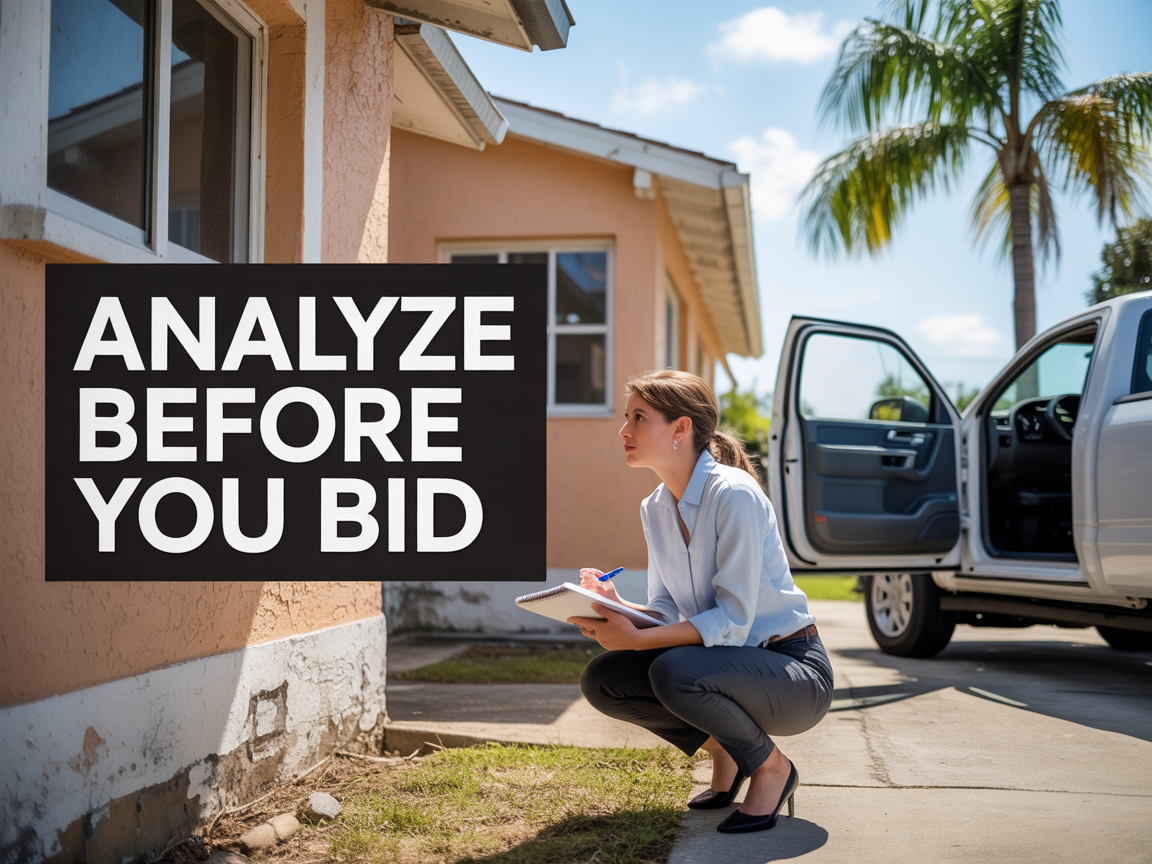
Winning at a Florida auction is only part of the equation. The investors who consistently make money at foreclosure and tax deed sales are the ones who know exactly what a property is worth before they ever set foot in the auction room. Learning how to analyze a florida investment property using the right financial metrics is what separates a profitable bid from an expensive mistake. Raw instinct and a quick walk around the block is not a system. Cap rate, gross rent multiplier, price-to-rent ratio, and a disciplined approach to rehab cost estimation are the tools that turn auction research into a repeatable, numbers-driven process.
This guide covers the core metrics every Florida auction investor should be running before setting a maximum bid. Whether you are flipping, holding as a rental, or wholesaling after acquisition, each of these tools gives you a different angle on the same question: is this deal actually worth what it will cost me to buy it?
Why You Must Analyze a Florida Investment Property Before Setting Your Max Bid
The auction environment creates real psychological pressure to bid. You have done the research, you want the deal, and there is someone else bidding against you. Without a hard number derived from actual financial analysis, that pressure will push you to overpay. The only protection against overpaying at auction is arriving with a maximum bid you calculated in advance and refusing to go above it regardless of what happens in the room or on the screen.
To analyze a florida investment property properly, you need to know your intended exit strategy before you run the numbers. A property you plan to flip has a completely different maximum acquisition price than the same property held as a long-term rental. Running both sets of numbers before you bid gives you a range and helps you understand which exit gives you the best return at each price point. Starting with thorough due diligence in real estate before any financial modeling ensures your inputs are based on reality rather than optimistic assumptions.
Cap Rate: The Standard Rental Return Metric
Cap rate, or capitalization rate, is the most widely used metric to analyze a florida investment property for rental income potential. It measures the annual net operating income a property generates as a percentage of its value. The formula is straightforward: divide the net operating income by the property value, and multiply by 100 to express as a percentage.
Net operating income is your gross annual rent minus all operating expenses, excluding mortgage payments. Operating expenses include property taxes, insurance, property management fees, maintenance and repairs, vacancy allowance, and any HOA dues. For Florida auction properties, be conservative on vacancy and maintenance estimates. A property that sat vacant through a lengthy foreclosure process may need significant work before it can command full market rent.
Understanding cap rate in real estate also means understanding what cap rate is appropriate for the market and property type you are targeting. Florida markets vary considerably. A cap rate that is acceptable in a working-class neighborhood in Polk County may be considered low in a premium Miami Beach location. Comparing the cap rate of your target property against comparable rental properties in the same submarket tells you whether your return is competitive or whether you are overpaying for the income stream.
Gross Rent Multiplier: A Quick Screening Tool
The gross rent multiplier is a faster and simpler tool to analyze a florida investment property at the screening stage before you commit to a full analysis. The GRM is calculated by dividing the property price by its annual gross rental income. If a property would rent for $1,500 per month and you are considering a maximum bid of $150,000, the GRM is 150,000 divided by 18,000, which equals 8.3.
The gross rent multiplier does not account for expenses, so it is not a final decision tool. But it is an excellent first filter. If you have established from comparable sales in the area that similar properties trade at a GRM of 7 to 9, and your target property at your proposed bid puts you at a GRM of 12, that gap alone tells you your bid needs to come down significantly before the deal makes sense as a rental hold.
GRM is particularly useful when you are evaluating multiple auction properties in the same session. Running a quick GRM calculation on each one based on your research into local rental rates lets you rank the opportunities in minutes before doing deeper analysis on the most promising candidates.
Price-to-Rent Ratio: Market-Level Context for Your Decision
While cap rate and GRM analyze individual properties, the price-to-rent ratio gives you market-level context to evaluate whether a given Florida submarket favors buying or renting. The ratio is calculated by dividing the median home price in an area by the median annual rent. A ratio below 15 generally indicates a buy-favorable market where owning makes more financial sense than renting. A ratio above 20 suggests a market where renting is relatively more affordable for tenants, which can limit your rental income upside even if the property looks cheap at auction.
When you analyze a florida investment property for rental hold potential, checking the price to rent ratio in that specific market helps you set realistic rent expectations. In a high price-to-rent market, tenants have relatively more incentive to rent than buy, which can support rental demand. In a low price-to-rent market, strong buy demand can drive appreciation, making flips more attractive than holds. Both situations can be profitable; the ratio just tells you which strategy has the structural tailwind in that location.
Estimating Rehab Costs Before You See Inside
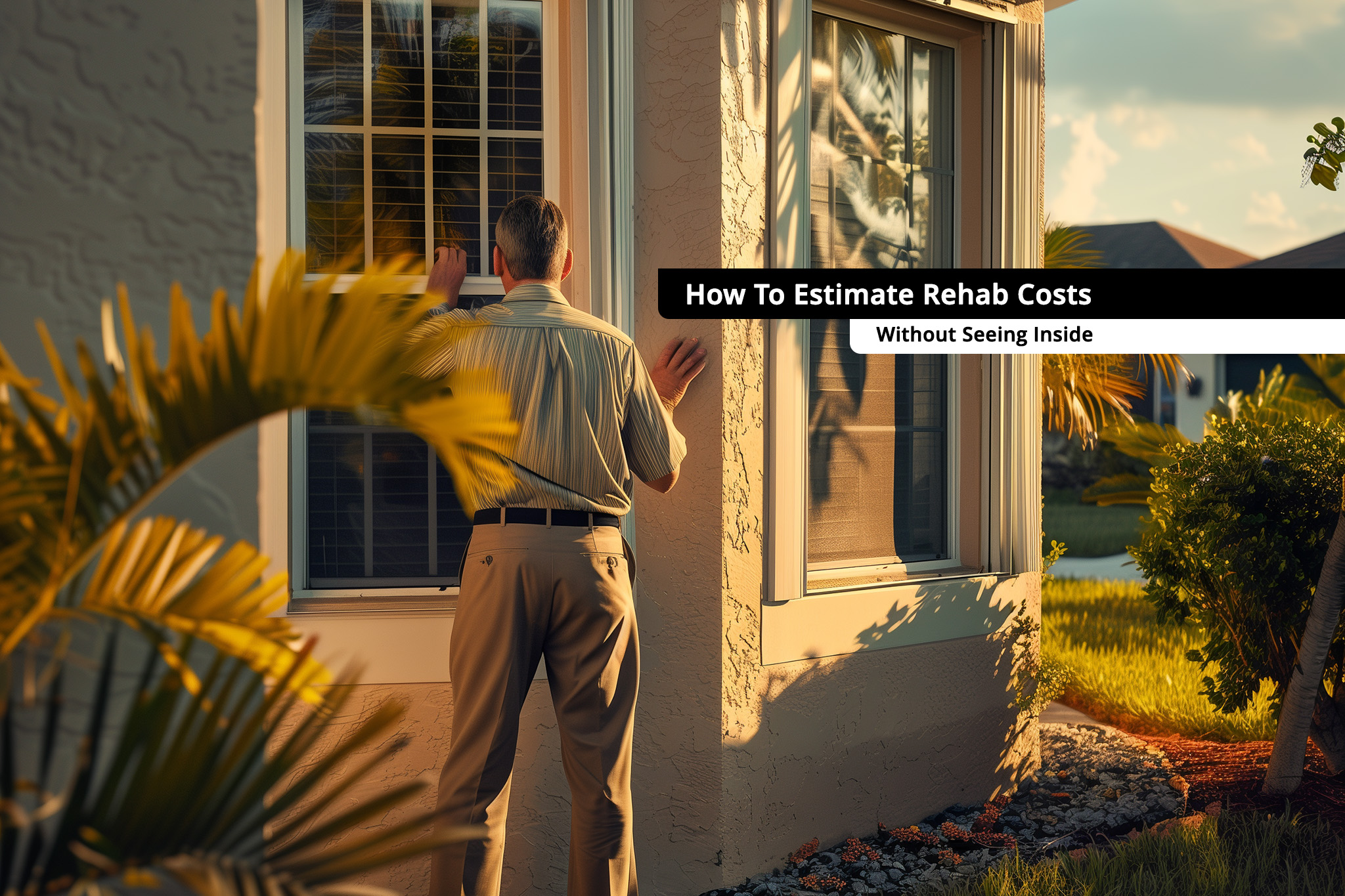
Most Florida auction properties cannot be inspected before the sale. You are bidding on a property you may only have seen from the exterior. This makes the ability to estimate rehab costs from limited information one of the most valuable skills an auction investor can develop.
Start with the exterior assessment. Roof condition is the most expensive unknown on most residential properties. Look at the age of the roof material, visible sagging, missing tiles or shingles, and staining on the fascia. A roof replacement in Florida currently runs anywhere from $8,000 to $25,000 or more depending on size and material. If the roof looks like it needs replacement, build that number into your worst-case rehab estimate.
HVAC is the second major unknown on exterior-only assessments. Florida HVAC systems typically last 10 to 15 years in the humid climate. If the unit looks older than that or is visibly deteriorating, budget a replacement. New HVAC systems in Florida run $4,000 to $10,000 installed depending on the size of the home. Add plumbing and electrical unknowns based on the age of the home, and you have a rough worst-case rehab budget that protects you from the biggest surprises.
The approach most experienced investors use is to build a tiered rehab estimate: a light cosmetic number assuming no major systems failures, a medium number with one major system replacement, and a heavy number assuming roof plus HVAC plus plumbing issues. Set your maximum bid so that even your heavy rehab scenario produces an acceptable return. If the numbers only work in the light cosmetic scenario, the deal is too risky for an auction purchase where you cannot verify condition before bidding.
Building Your Maximum Bid From the Numbers
Once you have run cap rate, GRM, price-to-rent ratio, and your rehab estimate, you have everything you need to calculate a defensible maximum bid. For a flip, work backward from the after-repair value. Determine the ARV from comparable closed sales, subtract your rehab estimate, subtract your desired profit margin, subtract your holding and transaction costs, and the resulting number is your maximum acquisition cost. At auction, your maximum bid cannot exceed that number.
For a rental hold, use the cap rate target to work backward to a purchase price. If comparable rentals in the area trade at a 7 percent cap rate and your property will generate $14,000 per year in net operating income after expenses, the implied value at a 7 percent cap is $200,000. Bid below that number to build in a margin of safety, and build your rehab cost into the basis as well.
The discipline of completing this analysis before every auction bid is what allows you to analyze a florida investment property objectively rather than emotionally. When you know your number is $147,000 based on the math, and the bidding goes to $148,000, you stop. The analysis is only useful if you honor it in the room.
If you hold properties beyond the initial acquisition, also consider the long-term tax implications of your strategy. Understanding how a 1031 tax exchange works can significantly affect your after-tax returns when you eventually sell a rental property you acquired at auction, and it is worth building that strategy into your overall investment plan from the beginning.
Ready to Buy Smarter at Florida Auctions?
PropertyOnion offers a 1-on-1 foreclosure and tax auction course that walks serious investors through the full process from property research to closing day. We also provide professional title search services so you know exactly what you are buying before you bid. Visit PropertyOnion.com to learn more about the course and title search services.






Comments