The latest foreclosure data is in, and for Florida real estate investors, the numbers tell a story that should have you moving quickly. ATTOM’s January 2026 U.S. Foreclosure Market Report, released on February 11, 2026, reveals that foreclosure activity across the nation rose year over year for the eleventh consecutive month. Nationally, 40,534 properties received a foreclosure filing in January, representing a 32 percent increase from the same period last year. Foreclosure starts climbed 26 percent year over year, and completed foreclosures jumped a staggering 59 percent. For investors who specialize in county foreclosure auctions, this is not just a trend to watch. It is a signal to act.
Florida, in particular, sits at the epicenter of this foreclosure wave. The Sunshine State ranked third in the nation for worst foreclosure rates, with one in every 2,067 housing units carrying a foreclosure filing in January 2026. Florida also led the entire country in foreclosure starts, recording 3,523 new foreclosure initiations, more than any other state including Texas and California. Two Florida metro areas, Punta Gorda and Lakeland, ranked among the top five nationally for worst foreclosure rates among metros with populations over 200,000. Miami alone generated 851 foreclosure starts, placing it fourth among all major metros in the country.
If you have been waiting for the right time to scale your foreclosure auction investing in Florida, that time is now. The pipeline of distressed properties flowing into the county auction system is growing month over month, and the investors who are prepared, educated, and equipped with the right tools are the ones who will capture the best deals before the competition catches on.
What the January 2026 Data Means for Florida Auction Investors
To fully appreciate the opportunity sitting in front of Florida investors right now, you need to understand what these foreclosure numbers actually represent and how they translate into inventory at the county level. When ATTOM reports 3,523 foreclosure starts in Florida for January 2026, that figure includes Notices of Default and Lis Pendens filings. In Florida’s judicial foreclosure system, a Lis Pendens is the formal notice that a foreclosure lawsuit has been filed against a property. That filing kicks off a legal process that, depending on the county and the complexity of the case, typically takes several months to over a year before the property reaches a foreclosure auction sale.
What this means practically is that the 3,523 foreclosure starts recorded in January 2026 represent future auction inventory. These properties are entering the pipeline right now, and they will eventually appear on county foreclosure auction calendars across the state. When you combine this with the foreclosure starts from the previous months, which have also been running at elevated levels throughout 2025 and into early 2026, you begin to see a picture of steadily growing auction inventory that will continue to build over the coming quarters.
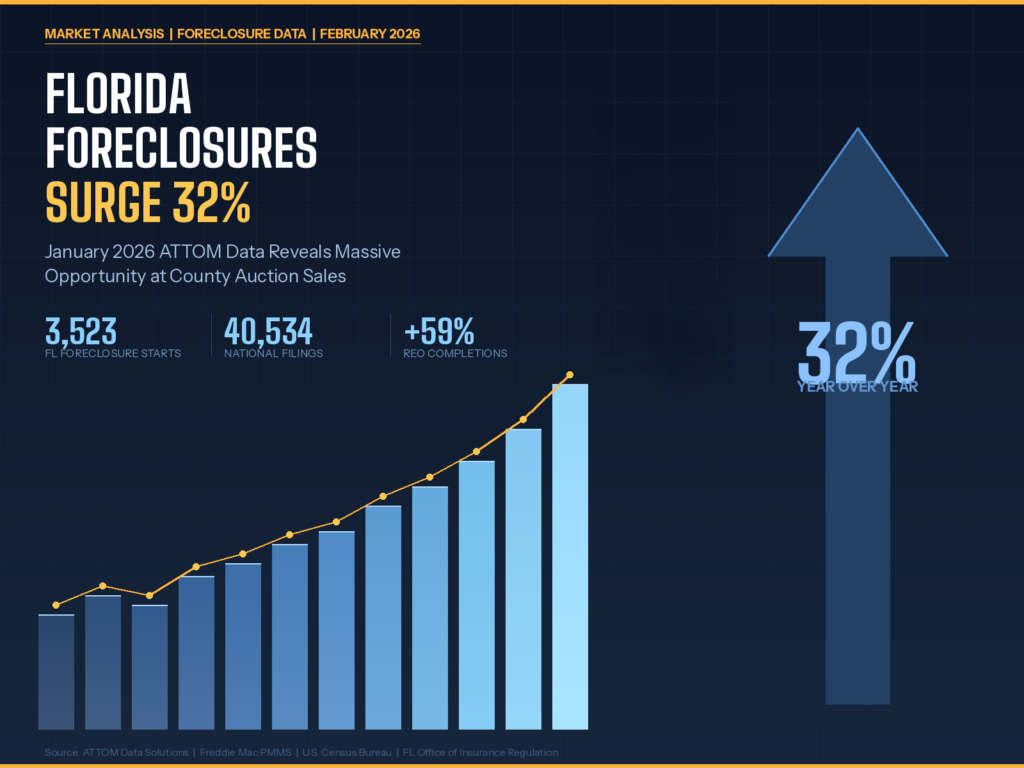
January 2026 Florida Foreclosures Surge 32%: Massive Opportunity at County Auction Sales
The 59 percent year-over-year increase in completed foreclosures nationally is equally telling. In Florida, 327 properties were repossessed by lenders through completed foreclosures (REOs) in January 2026 alone. While REO properties follow a different disposition path than auction sales, the overall increase in completed foreclosures signals that lenders are moving more aggressively through the foreclosure process. Cases that might have lingered in the court system during the post-pandemic period are now being pushed through to resolution, and that resolution increasingly means a property hitting the auction block.
Rob Barber, CEO of ATTOM, noted in the report that “although foreclosure activity has been rising steadily, overall levels remain well below historic peaks.” This is a critical point for investors. We are not in a 2008-style crisis where the entire market is collapsing. Instead, we are in a normalization phase where foreclosure activity is returning to more typical pre-pandemic levels after years of artificially suppressed inventory due to government moratoriums and forbearance programs. This normalization creates a sweet spot for knowledgeable investors because auction inventory is growing, but the broader market is not in freefall, meaning property values remain relatively stable and the profit potential on well-researched auction purchases is strong.
Florida Metro Areas Leading the Foreclosure Surge
The ATTOM data highlights specific Florida metro areas that are experiencing particularly high foreclosure activity, and these markets deserve close attention from auction investors. Punta Gorda recorded the second-worst foreclosure rate in the entire nation among metros with populations over 200,000, with one foreclosure filing for every 1,187 housing units. Lakeland followed closely, ranking fourth nationally with one filing for every 1,262 housing units. These are not small, obscure markets. These are growing Florida communities with active real estate demand, which means foreclosure auction properties in these areas carry strong resale and rental potential.
Miami’s 851 foreclosure starts in January placed it among the top five metros nationally for new foreclosure activity. The broader South Florida market, including Broward and Palm Beach counties, continues to see significant foreclosure volume as well. For investors working these counties, the foreclosure auction calendars are getting longer, which means more opportunities to find properties at below-market prices. But it also means more competition from other investors who are reading the same data and arriving at the same conclusions.
Other Florida markets showing elevated foreclosure activity include the Orlando metro area, Jacksonville, and the Tampa Bay region. Each of these markets has its own dynamics in terms of property values, rental demand, and local court processing times, which affect how quickly properties move from filing to auction. Savvy investors do not treat Florida as a monolithic market. They study the specific counties where they plan to bid, understand the local auction procedures, and target the property types that align with their investment strategy.
The Economic Forces Pushing Florida Homeowners Into Foreclosure
Understanding why foreclosures are rising in Florida is just as important as knowing the numbers, because the underlying economic pressures driving this trend show no signs of easing anytime soon. Multiple financial forces are converging on Florida homeowners simultaneously, and when you look at the data behind each one, the case for continued foreclosure growth becomes clear.
Start with mortgage rates. According to Freddie Mac’s Primary Mortgage Market Survey, the 30-year fixed-rate mortgage averaged 6.11 percent as of February 5, 2026. While that represents a meaningful decline from the 6.89 percent average recorded a year ago, rates remain far above the sub-3 percent levels that many current homeowners locked in during 2020 and 2021. Homeowners who purchased at peak prices with adjustable-rate mortgages or who refinanced into short-term products are now facing payment resets at significantly higher rates. For borrowers already stretched thin by rising costs in other areas, even a modest payment increase can be the trigger that pushes them from struggling to defaulting.
Insurance costs represent another massive pressure point for Florida homeowners. Despite recent signs of market stabilization following legislative reforms in 2022 and 2023, Florida remains one of the most expensive states in the nation for homeowners insurance. According to an Insurance.com report cited by National Mortgage News, Florida had the highest average homeowners insurance premiums in the country at $7,136 in 2025. While that figure actually represented a 6 percent decline from $7,562 two years earlier, it still dwarfs the national average of $2,543. For many Florida homeowners, particularly those on fixed incomes or with tight monthly budgets, an annual insurance bill approaching or exceeding $7,000 on top of their mortgage payment, property taxes, and flood insurance creates an untenable financial situation.
The Florida Office of Insurance Regulation has approved a glidepath for Citizens Property Insurance Corporation, the state’s insurer of last resort, that increases the annual rate cap by 1 percent each year, reaching 15 percent in 2026. For primary residence policyholders, the statewide average Citizens increase was estimated at 6.6 percent in 2025, and non-primary residences, including investment properties and vacation homes, faced even steeper increases of up to 50 percent. While private carriers have begun returning to the market and some have even filed for rate decreases, the cumulative effect of years of double-digit premium increases has already pushed many homeowners past their breaking point.
Florida’s condominium market faces a unique additional pressure that is accelerating foreclosures in that segment. Following the Surfside condominium collapse in 2021, the Florida Legislature passed Senate Bill 4-D and subsequent legislation requiring mandatory Structural Integrity Reserve Studies (SIRS) and full reserve funding for condominium buildings three stories or taller. Starting January 1, 2026, structural reserves identified in a SIRS can no longer be waived or reduced and must be fully funded each year. For associations that spent decades underfunding their reserves, this mandate is triggering massive special assessments that individual unit owners must pay. Some associations are seeing assessments of tens of thousands of dollars per unit, and owners who cannot absorb those costs are defaulting on their association obligations, which can lead to HOA lien foreclosures, or falling behind on their mortgages as the cumulative financial burden becomes unsustainable.
Population growth adds yet another dimension to this story. According to U.S. Census Bureau estimates, Florida’s population topped 23.3 million in 2024, making it the fastest-growing state in the nation with an 8.24 percent increase since 2020. That population surge drove property values, property tax assessments, and demand for housing services to record levels. But it also means that a larger pool of homeowners is now exposed to the financial stresses described above. More homeowners under pressure means more foreclosure filings, which means more auction inventory for investors who are positioned to capitalize.
Property taxes add yet another layer of financial pressure. According to Kiplinger’s analysis of Florida tax data, property taxes in Florida have surged nearly 60 percent over the past five years, particularly in booming metro areas. In Jacksonville, the typical homeowner now pays nearly 60 percent more in property taxes than before the pandemic, with a total annual bill of approximately $2,735. In Tampa, bills jumped over 56 percent, and in Miami, property taxes grew 48 percent to a total of $4,401 annually. While Florida’s Save Our Homes amendment caps annual assessed value increases at 3 percent or CPI for homesteaded properties, non-homesteaded properties, including rental and investment properties, face a 10 percent annual cap, and properties that change hands are reassessed at full market value upon transfer. For homeowners who purchased during the pandemic boom at elevated prices, their property tax bills reflect those inflated values, and when combined with insurance premiums and rising HOA fees, the total cost of ownership can quickly exceed what their income supports.
The convergence of all these factors, elevated mortgage rates, record insurance premiums, mandatory condo reserve assessments, surging property taxes, and a massive population that magnifies every trend, creates a foreclosure environment unlike anything Florida has seen since the aftermath of the 2008 financial crisis. But critically, this time the underlying market fundamentals are stronger. Home values are supported by genuine demand from population growth and constrained new construction, which means that properties acquired at auction discounts carry strong profit potential on the resale or rental side. This is the rare market condition where distressed inventory is rising while underlying property values remain stable, and that combination is the ideal environment for informed auction investors.
Why Positioning Yourself Now Is Critical
The foreclosure auction landscape in Florida is competitive, and it is getting more so as the data continues to show rising inventory. Investors who wait until a property appears on the auction calendar to start their research are already behind. The most successful foreclosure auction investors in Florida operate with a proactive, research-first approach. They are monitoring Lis Pendens filings as they come in, identifying target properties months before the auction date, conducting thorough title searches to understand the lien structure, and building their bid strategies well in advance.
This is where preparation separates the profitable investors from the ones who overpay, buy into clouded title situations, or miss out on the best properties entirely. At the county foreclosure auction, you do not get a contingency period. You do not get to order an inspection after the fact. You are bidding on a property based on the research you have done beforehand, and if your research is incomplete or flawed, the financial consequences can be severe. A missed lien, an unresolved code violation, or a misunderstanding of the bid distribution process can turn what looked like a great deal into a costly mistake.
The rising foreclosure numbers also mean that many new investors are entering the auction space, attracted by the growing inventory and the potential for below-market purchases. While more inventory is good for everyone, more competition from underprepared bidders can drive up prices on certain properties and create situations where the winning bid exceeds what the property is actually worth to a disciplined investor. Your edge in this environment comes from knowledge, preparation, and access to reliable research tools.
What to Expect for the Rest of 2026
All indicators suggest that foreclosure activity in Florida will continue to rise throughout 2026. The eleven consecutive months of year-over-year increases at the national level, as documented by ATTOM, reflect a sustained trend, not a one-time spike. The economic factors driving this trend, including mortgage rates that remain historically elevated according to Freddie Mac data, insurance costs that still rank among the highest in the nation per Bankrate’s state-by-state analysis, increasing property taxes, and broader cost-of-living pressures are pushing more homeowners into financial distress.
Florida’s unique market dynamics amplify these pressures. The state has experienced the fastest population growth in the nation since 2020, according to U.S. Census Bureau data, driving up property values and, consequently, property tax assessments and insurance premiums. Homeowners who purchased or refinanced at the peak of the market with adjustable-rate mortgages or minimal equity are particularly vulnerable. Additionally, Florida’s condominium market faces its own set of challenges, with the new mandatory reserve funding requirements under the post-Surfside legislation taking full effect in 2026, creating financial strain on associations and individual unit owners alike. According to the Florida Department of Business and Professional Regulation, all condominium and cooperative associations are now required to create online accounts and submit SIRS-related information to the state, and associations that cannot demonstrate full reserve funding compliance face potential board liability. The financial ripple effects of these requirements will continue to push distressed condo units into the foreclosure pipeline for years to come, creating a distinct subcategory of auction opportunity that savvy investors are already targeting. All of these factors contribute to a foreclosure environment that is likely to remain active well into 2027.
The HOA and condo association fee situation deserves special attention from auction investors because it is creating a foreclosure dynamic that did not exist at this scale in prior cycles. When a condo association levies a special assessment of $20,000, $50,000, or even more per unit to meet mandatory reserve requirements, some percentage of unit owners simply cannot pay. Those unpaid assessments become association liens on the property, and Florida law gives associations the right to foreclose on those liens. HOA and COA lien foreclosure auctions operate under a different framework than mortgage foreclosures, with different lien priority rules and different risks for buyers, but they represent a growing source of auction inventory across Florida’s 67 counties. According to National Mortgage News, Florida is a clear outlier for HOA costs nationally, with rising insurance premiums and stricter safety and reserve requirements driving up association operating expenses that ultimately get passed on to homeowners. Investors who understand the nuances of HOA lien foreclosures are finding opportunities that most of the market overlooks entirely.
For auction investors, this extended runway of elevated foreclosure activity is an extraordinary opportunity, but only if you are prepared to take advantage of it. The investors who build their knowledge base now, establish their research workflows, and develop relationships with the right service providers will be positioned to acquire properties at significant discounts throughout this cycle. Those who try to jump in without preparation will find themselves competing against better-informed bidders and making costly mistakes that could have been avoided.
Get the Expert Training and Research Tools You Need to Win at Auction
The data could not be clearer. Florida’s foreclosure pipeline is expanding, auction inventory is growing, and the opportunity for well-prepared investors is as strong as it has been in years. But opportunity without preparation is just risk by another name. If you want to compete effectively at Florida’s county foreclosure auctions and tax deed sales, you need the right education and the right tools.
If you are serious about capitalizing on Florida’s growing foreclosure auction inventory, there is no substitute for proper education. The county foreclosure auction process in Florida is governed by specific statutory requirements under Florida Statutes Chapter 45 and Chapter 702, and understanding these rules is not optional. You need to know how the final judgment amount is calculated, what happens when there are competing liens on a property, and how the certificate of title process works after you win a bid. You also need to understand the differences between mortgage foreclosure auctions, HOA and COA lien foreclosure auctions, and tax deed sales, because each one operates under a different legal framework with different risks and opportunities.
Our 1-on-1 Foreclosure and Tax Auction Course is designed specifically for investors who want to go beyond the basics and develop true expertise in Florida’s auction systems. This is not a generic webinar or a pre-recorded video series. It is a personalized, one-on-one training experience where you work directly with an experienced auction investor who walks you through every aspect of the foreclosure and tax deed auction process. You will learn how to read and interpret Lis Pendens filings, how to analyze the lien priority stack on any property, how to calculate your maximum bid based on after-repair value and holding costs, and how to navigate the post-auction process from certificate of title through disposition.
The course also covers tax deed auctions in depth, including how Florida’s tax certificate system works under Chapter 197, the redemption rights that apply to different property types, and the strategies that experienced investors use to identify the highest-value tax deed opportunities before they go to sale. With foreclosure activity rising month after month, the investors who take the time to build a proper foundation of knowledge now will be the ones best positioned to profit as auction inventory continues to grow throughout 2026.
Education gives you the knowledge to understand the auction process, but execution requires the right research tools. Every successful auction bid starts with thorough due diligence, and the cornerstone of that due diligence is a comprehensive title search. Before you bid on any property at a Florida foreclosure auction, you need to know exactly what liens, encumbrances, and interests are attached to the title. A mortgage foreclosure auction extinguishes the foreclosing lien and any junior liens, but it does not eliminate liens that are senior to the one being foreclosed. If you do not know the full lien structure before you bid, you could end up purchasing a property subject to a senior mortgage, unpaid property taxes, municipal liens, or other encumbrances that dramatically reduce your profit margin or even put you in a negative equity position.
Our platform provides investors with the research capabilities they need to evaluate foreclosure and tax deed auction properties with confidence. Through our title search services, you get a detailed report on the chain of title, recorded liens, judgments, and other encumbrances affecting any property you are considering. This is not a generic property report pulled from a database. It is a thorough examination of the public records that gives you a clear picture of what you are buying and what risks you may be taking on.
The platform also gives you access to tools for identifying upcoming auction properties, tracking foreclosure filings across multiple Florida counties, and analyzing property values and comparable sales to support your bidding strategy. When you combine these research tools with the knowledge you gain from our 1-on-1 course, you have everything you need to operate as a professional-level foreclosure auction investor in any Florida county.
The foreclosure numbers are going up. The auction calendars are getting longer. The question is whether you will be ready when the next great property hits the auction block. Contact us today to learn more about our 1-on-1 course and platform services, and start building the skills and systems you need to succeed in Florida’s foreclosure and tax auction market.