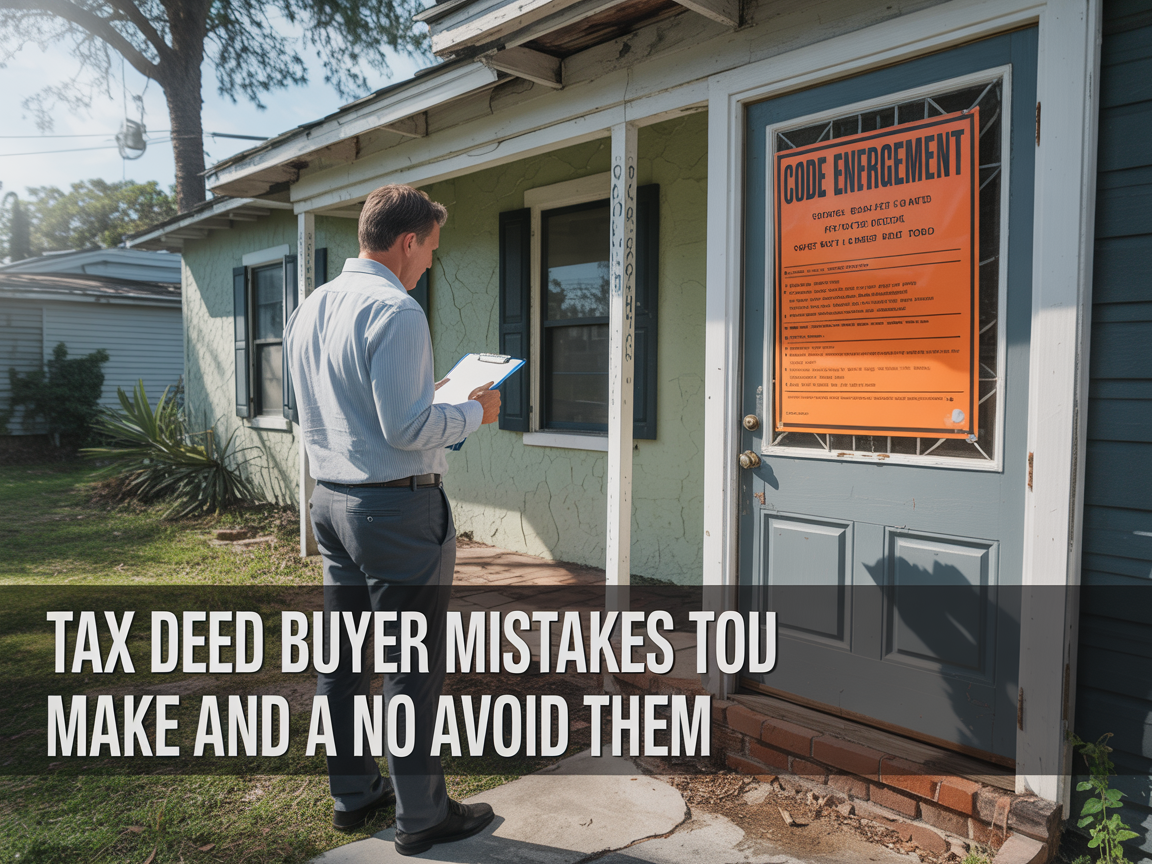
Florida tax deed auctions attract a steady stream of new investors every year, drawn by the promise of acquiring properties significantly below market value. Many of them walk into their first few sales with enough general knowledge to be dangerous but not enough specific experience to avoid the mistakes that cost real money. The florida tax deed buyer mistakes that show up most consistently are not random bad luck. They are predictable patterns that experienced investors have learned to avoid through expensive lessons, and that new buyers keep repeating because no one laid them out plainly in advance.
This article covers the most consequential florida tax deed buyer mistakes, why each one happens, and how to systematically protect yourself from making them. If you are relatively new to the Florida tax deed market, reading this before your first auction is worth far more than the time it takes.
The Most Costly Florida Tax Deed Buyer Mistakes and How to Avoid Them
Before diving into the specific mistakes, one overarching principle applies to all of them: the tax deed auction environment creates urgency and competition that bypass your normal decision-making process if you let it. Most florida tax deed buyer mistakes happen because an investor did not do their research before the auction and made up for it with excitement and optimism during the bidding. The antidote is always preparation, not more experience standing in an auction room.
Mistake One: Skipping the Title Search
The single most expensive mistake a new tax deed buyer can make is bidding on a property without first completing a thorough title search. A tax deed sale does not operate like a foreclosure auction. It does not extinguish all prior liens automatically through a judicial process. Mortgages, judgment liens, HOA assessments, code enforcement liens, and IRS federal tax liens can all survive a tax deed sale depending on lien priority and whether proper notice was given to the lienholders.
Investors who skip the title search and discover a $60,000 mortgage that survived the tax deed sale after winning at auction have no recourse. The sale is final. The lien is real. Their only options are to pay off the lien, attempt to negotiate a settlement, or walk away from the property and absorb the loss. A florida title search completed before the auction would have revealed that lien and allowed the investor to either price it into their bid or skip the property entirely. This is not a shortcut worth taking on any property regardless of how attractive it looks at first glance.
Mistake Two: Ignoring the Quiet Title Requirement
A second major category of florida tax deed buyer mistakes involves underestimating or ignoring the quiet title requirement that applies to most tax deed properties in Florida. Because the tax deed process does not go through a full judicial foreclosure, title insurance companies are generally unwilling to insure tax deed properties without a quiet title action that clears any potential claims against the title through the court system.
Without title insurance, you cannot get conventional financing on the property. Without conventional financing, your buyer pool for a resale is limited to cash buyers. Without a large buyer pool, your resale price and timeline are both worse than they would be with insurable title. For investors planning to flip or refinance a tax deed acquisition, the inability to obtain title insurance is not a minor inconvenience. It fundamentally alters the deal economics.
The quiet title process in Florida takes several months and costs several thousand dollars in legal fees. These costs and timelines need to be factored into your bid before auction day, not discovered afterward. Understanding exactly what a quiet title action florida entails and budgeting for it upfront is what separates investors who close profitable tax deed deals from those who win auctions and then struggle to monetize what they bought.
Mistake Three: Overbidding Based on Assessed Value Instead of Market Value
New investors frequently make the mistake of using the county property appraiser’s assessed value as their benchmark for determining how much to bid. The assessed value and the market value of a Florida property are two very different numbers, and conflating them leads to significant overbidding at tax deed auctions.
Florida’s Save Our Homes amendment caps annual increases in assessed value for homestead properties at 3 percent per year, meaning a property that has been homesteaded for many years may have an assessed value that is far below its actual market value. Conversely, properties that have been vacant, neglected, or whose assessments have not been recently updated may have assessed values that are above current market reality. Before you set a maximum bid on any tax deed property, run your own comparable sales analysis using recent closed sales of similar properties in the same neighborhood. That exercise is the core of how you apply real estate due diligence to auction property valuation.
Mistake Four: Not Checking Code Enforcement Liens
Code enforcement liens are among the most overlooked items in the category of florida tax deed buyer mistakes. Unlike most other liens, code enforcement liens are imposed by municipalities and counties for property condition violations and can accrue at rates of $50 to $500 per day from the date of the violation notice. A property that has been in disrepair and in the tax delinquency process for several years can easily accumulate tens of thousands of dollars in code enforcement fines before the tax deed sale ever takes place.
Critically, code enforcement liens attach to the land itself and can survive a tax deed sale. A winning bidder who inherits a $75,000 code enforcement lien has a problem that goes far beyond what they paid at auction. These liens must be searched separately from the standard title search. Contact the code enforcement office for the municipality where the property is located directly, and request a lien search by property address. Many Florida cities and counties also have online portals where open violation cases can be searched. This is a step that adds 30 minutes to your pre-bid research and can save you from a catastrophic post-auction surprise.
Mistake Five: Misunderstanding the Redemption Period
The florida tax deed redemption period gives the delinquent property owner the right to pay all outstanding taxes, interest, and fees and reclaim their property up until the point the tax deed is actually issued. New investors sometimes win a tax deed auction and assume they immediately own the property. The reality is that the redemption right exists up until the clerk of court actually issues the deed, which can be several days to a few weeks after the auction depending on the county.
This means an investor who wins a tax deed auction and immediately begins spending money on inspections, attorney fees, or preliminary work before the deed is issued is taking on a risk that may not materialize. In practice, redemptions after the auction are uncommon because the owner would have needed to come up with the full amount earlier in the process. But the possibility is real, and understanding the exact redemption deadline for the county and property in question is part of a complete pre-bid review.
Mistake Six: Underestimating the Holding Costs
Tax deed properties often require a quiet title action, which takes months. During that time the investor is carrying the property with no ability to refinance or sell to a conventional buyer. Property taxes continue to accrue during the quiet title period. Insurance on a vacant property costs more than insurance on an occupied one. Any necessary boarding, securing, or maintenance of the property comes out of the investor’s pocket. For properties that also need significant rehab before they are habitable or marketable, the holding cost clock starts running from day one after the auction and does not stop until the property closes with a buyer.
Investors who bid based solely on a quick calculation of purchase price versus estimated after-repair value, without carefully modeling the holding cost period, frequently end up with deals that look profitable on paper and break even or lose money in practice. The full holding cost model needs to account for property taxes, insurance, utilities if kept on, security, quiet title legal fees, any HOA dues that survive the sale, and the interest cost on whatever financing was used to acquire the property.
For investors who eventually plan to sell land acquired at a tax deed sale, understanding the specific challenges and strategies around how to sell land after a tax deed sale is essential reading before bidding on vacant parcels. Land has different holding cost dynamics and a narrower buyer pool than improved residential properties, and those differences need to be understood before bidding.
Building a System That Avoids These Mistakes Consistently
The investors who avoid florida tax deed buyer mistakes consistently are not necessarily more experienced or more intelligent than those who make them. They are more systematic. They have a pre-bid checklist that does not change based on how excited they are about a particular property. They run every property through the same research process whether it is their first auction bid or their hundredth. They have a maximum bid number derived from actual financial analysis and they honor it without exception during the bidding.
Developing that systematic discipline is something every investor can do, and it is what the most successful tax deed buyers in Florida have built their track records on. If you are looking to shortcut the learning curve and build that system faster, these research tips for florida tax deed sales are a strong complement to the mistake-avoidance framework laid out here.
Ready to Buy Smarter at Florida Auctions?
PropertyOnion offers a 1-on-1 foreclosure and tax auction course that walks serious investors through the full process from property research to closing day. We also provide professional title search services so you know exactly what you are buying before you bid. Visit PropertyOnion.com to learn more about the course and title search services.







Comments