When traditional MLS inventory is thin, tapping florida foreclosure inventory through the auction and tax deed pipeline gives savvy investors access to acquisition opportunities that are completely unavailable through conventional channels and largely invisible to retail buyers.
Florida’s real estate market has always been attractive to investors seeking profitable opportunities at tax deed auctions and foreclosure sales. These events offer the chance to acquire properties at discounted prices, making them lucrative ventures. However, recently, the limited real estate inventory in Florida has significantly affected investors’ prospects, leading to both challenges and opportunities in the market.
Investors need to be more strategic and cautious with their bids to ensure they don’t overpay for a property.
Since COVID, Florida has seen a dramatic shift in housing inventory from a high of 155,000 listings in 2019, to a low of 35,000 listings in January 2022. In June of 2023, the number of listings is back to 83,000, but that is still very low.
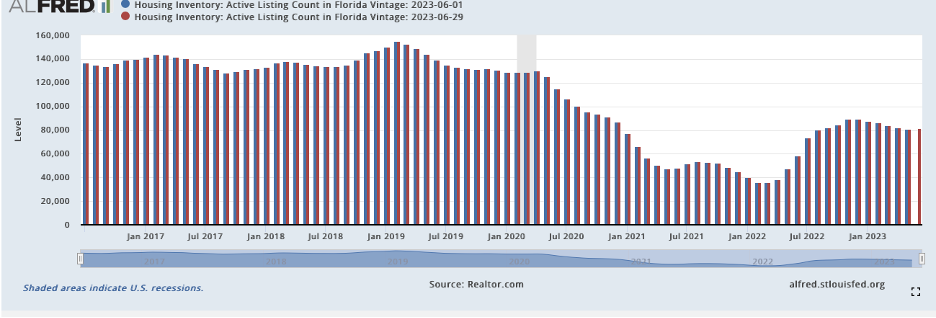
The lack of available properties has resulted from a growing demand for housing and investment properties in Florida. The state’s popularity as a vacation destination, retirement haven, and business hub has driven an influx of buyers, both residential and investors, seeking properties. This increased demand has led to a supply-demand imbalance, affecting the number of properties available at tax deed auctions and foreclosure sales.
As inventory remains limited, finding high-quality properties becomes a challenging task for investors.
With fewer properties on the market, the competition among investors at tax deed auctions and foreclosure sales has intensified. Bidding wars are now more common, driving property prices higher and eroding the potential profit margins for investors. As a result, investors need to be more strategic and cautious with their bids to ensure they don’t overpay for a property.
As inventory remains limited, finding high-quality properties becomes a challenging task for investors. Investors need to be ready to make smarter decisions on how to identify profits that others will not see. It could be in rehabbing properties with greater efficiency. It may be identifying legal encumbrances and liens that can be resolved but will usually deter novice investors from taking risks. Investors need to conduct thorough due diligence to identify properties with the potential for significant returns on investment. But with the right education and a deeper understanding of advanced strategies for investing in distressed assets, there are many layers of the onion to peel back. Savvy investors can expose profits other investors will miss.
While the shortage of inventory poses challenges for investors, it also creates opportunities in emerging markets within Florida.
The scarcity of available properties has forced investors to adapt their investment strategies. Some investors have shifted from focusing solely on tax deed auctions and foreclosure sales to exploring other avenues, such as probate properties, pre-foreclosure deals, off-market deals, distressed property purchases, or partnership opportunities with developers.
The lack of real estate inventory in Florida has made it particularly challenging for first-time investors to enter the market. With limited affordable options, newcomers face fierce competition from seasoned investors with deeper pockets and established networks. This makes it vital for first-time investors to educate themselves thoroughly and seek professional guidance.
Despite the challenges, opportunities still exist in emerging markets.
While the shortage of inventory poses challenges for investors, it also creates opportunities in emerging markets within Florida. As urban centers become more saturated, investors are exploring potential in suburban and rural areas. These regions may offer untapped potential with attractive property prices and growth prospects.
The limited real estate inventory in Florida has significantly impacted investors participating in tax deed auctions and foreclosure sales. Intense competition, rising property prices, and a shift in investment strategies have all been consequences of this imbalance. Despite the challenges, opportunities still exist in emerging markets, making it crucial for investors to adapt, strategize, and conduct comprehensive research to succeed in this dynamic environment. As the Florida real estate market continues to evolve, investors must stay informed and flexible to thrive in this competitive landscape.
How Foreclosure Auctions Fill the Gap When Florida Inventory Is Limited
When traditional MLS inventory is tight, savvy Florida investors turn to the foreclosure and tax deed auction pipeline to find acquisition opportunities that are not available through conventional channels. Foreclosure auctions operate independently of the broader housing market inventory, creating a consistent deal flow even during periods of historically low available listings.
The judicial foreclosure process in Florida creates a multi-year pipeline of distressed properties that move through the legal system on their own timeline, independent of market conditions. Investors who monitor lis pendens filings and court proceedings can identify potential auction opportunities months before properties ever reach the sale calendar.
Tax deed auctions offer an additional inventory channel when traditional listings are scarce. Properties that have accumulated unpaid tax balances cycle through the tax certificate and tax deed process on a government timeline rather than a seller motivation schedule, providing consistent acquisition opportunities regardless of what is happening with traditional home supply.
Investors who build a systematic approach to monitoring both foreclosure filings and tax certificate conversions across multiple Florida counties effectively multiply their available inventory by tapping sources that most traditional buyers never consider.
Building a Research Process for Auction Inventory
Participating in Florida foreclosure and tax deed auctions when traditional inventory is limited requires a well-organized research process. Unlike MLS purchases where you can schedule showings and request disclosures, auction properties are sold as-is with no seller representations, making your pre-auction research the only protection you have against costly surprises.
County clerk of court websites, property appraiser databases, and tax collector records are the three primary public data sources for researching any auction property thoroughly. Most Florida counties now publish all of these records online, making it possible to conduct meaningful due diligence from your desk before ever visiting a property in person.
Driving every auction candidate before bidding day is a non-negotiable step for serious investors. The exterior condition of a property tells you a significant amount about what the interior likely looks like, and comparing the exterior condition to comparable sold properties helps you calibrate your renovation budget and maximum bid before the auction event.
Investors who develop a consistent pre-auction research checklist and apply it to every property they evaluate build a significant competitive advantage over bidders who show up on auction day without having done their homework. That discipline separates investors who consistently win good deals from those who either overbid on problem properties or miss opportunities because they were not prepared.
When traditional inventory is tight, florida foreclosure auctions provide a consistent pipeline of below-market acquisition opportunities that operate completely independently of conventional MLS listing levels.
Understanding the florida foreclosure timeline helps investors identify properties entering the auction pipeline months before the sale date is scheduled, giving them time to research thoroughly before the auction event.
Tax deed auctions complement foreclosure auctions as an additional inventory channel. Our guide on florida tax deed sales guide explains how properties move from delinquent tax status through the auction process to new ownership.
Every property identified through these alternative inventory channels requires a thorough florida title search before bidding to ensure you understand the full lien picture and can calculate your true acquisition cost accurately.
Investors who want to understand all available acquisition channels should review the complete guide to county foreclosure tax deed auctions for a comprehensive overview of how both auction systems work in Florida.
Get Complete Florida Auction Coverage at PropertyOnion
Florida foreclosure and tax deed auctions move fast. PropertyOnion.com keeps you ahead with complete county coverage, research tools, and step-by-step eBook guides you can download and use immediately on your next deal.
Join and Download Free eBook