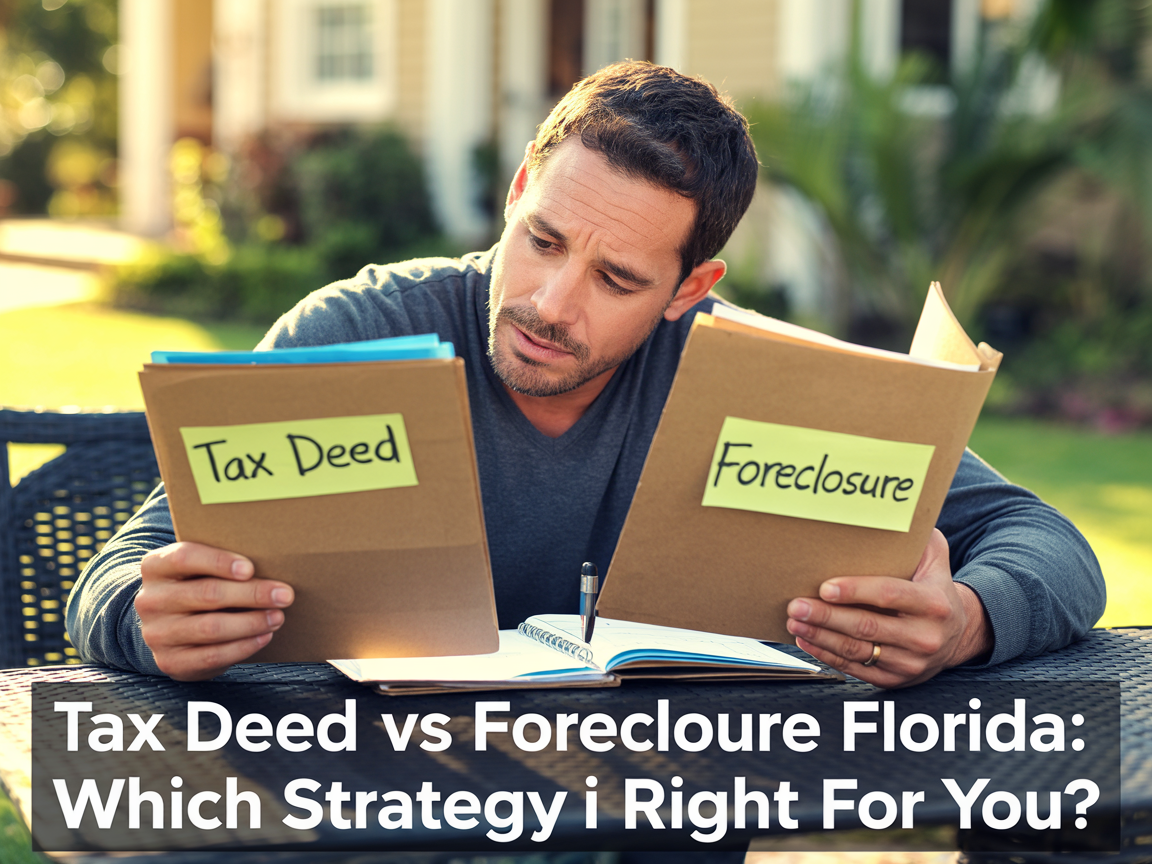
Florida offers real estate investors three distinct paths to acquiring distressed and below-market properties through public auction channels. Understanding the difference between a tax deed vs foreclosure florida investors have access to is not just academic. The strategy you choose determines your upfront capital requirements, your timeline to ownership, your title risk exposure, and your potential return on every deal. Each of these three paths operates under different statutes, different county processes, and different risk profiles. Getting clear on how they compare before you commit money to any of them is essential.
This breakdown is designed for investors who are serious about building a repeatable auction acquisition strategy in Florida. Whether you are deciding which approach fits your capital position, your risk tolerance, or your available time, the tax deed vs foreclosure florida comparison below gives you the framework to make that decision clearly.
Tax Deed vs Foreclosure Florida: The Core Differences
All three auction types involve distressed properties, but they arrive at the auction block through very different legal processes. A foreclosure auction results from a lender or lienholder filing a civil lawsuit to collect on an unpaid debt secured by the property. A tax deed sale results from a property owner failing to pay property taxes for an extended period, triggering the county tax collector to initiate a sale of the deed itself. A tax lien certificate sale is an earlier step in that same process, where the county sells the right to collect the delinquent taxes to a private investor before any deed changes hands.
Understanding florida foreclosure auctions starts with recognizing that these are judicial sales conducted after a court has issued a final judgment. Florida is a judicial foreclosure state, which means a lender cannot simply sell a property without going through the court system. That process takes time, often one to three years from filing to auction, but it also results in a relatively clean title extinguishing most junior liens. The tax deed vs foreclosure florida distinction matters here because the title outcome at each type of sale is fundamentally different.
How Foreclosure Auctions Work in Florida
In a Florida foreclosure auction, a lender or other lienholder has obtained a final judgment from a circuit court after the borrower defaulted on a secured debt. The court orders the property sold to satisfy that judgment. The auction is typically conducted online through county-approved platforms, with the lender setting the opening bid at or near the judgment amount plus fees and costs.
When you win a foreclosure auction, you receive a Certificate of Title issued by the clerk of court. This title extinguishes most junior liens that were properly named in the foreclosure suit. However, certain liens survive regardless, including IRS federal tax liens if the IRS was not given proper notice and redemption rights, and certain government assessments. Under Florida Statute 702, the foreclosure process is well defined, and the court’s involvement provides a level of title clarity that tax deed and tax lien paths do not always offer on their own.
The capital requirement is immediate and substantial. Most Florida counties require the winning bidder to post a deposit on the day of the sale and pay the full balance within 24 hours. This means you need cash or a hard money line ready before you bid. Knowing whether you have to pay cash at a foreclosure auction or whether financing options exist is a key part of your pre-bid planning.
How Tax Deed Sales Work in Florida
A Florida tax deed sale occurs after a property owner has failed to pay property taxes and a tax lien certificate on the property has been outstanding for at least two years. The certificate holder or the county itself can apply for a tax deed, triggering the clerk of court to schedule a public auction of the property. The proceeds satisfy the delinquent taxes, and the winning bidder receives a tax deed from the county.
The tax deed vs foreclosure florida comparison highlights a key distinction here: a tax deed sale does not go through the court system the same way a foreclosure does. This means the tax deed does not automatically extinguish all other liens. Mortgages, judgment liens, and other encumbrances may survive a tax deed sale depending on lien priority and whether proper notice was given. This is why many florida tax deed sales require a subsequent quiet title action before the new owner can obtain insurable title. That post-sale legal process adds cost and time to your deal, both of which need to be factored into your maximum bid.
The florida tax deed redemption period also plays a role here. The delinquent property owner has the right to redeem the property by paying all outstanding taxes, interest, and fees up until the point the tax deed is actually issued. Understanding where a property is in that redemption window affects your risk calculation as a bidder.
How Tax Lien Certificate Sales Work in Florida
Florida tax lien certificate sales happen earlier in the tax delinquency process, typically each spring. When a property owner fails to pay their annual property taxes, the county sells a tax lien certificate to the highest bidder at a public auction. The investor pays the delinquent taxes on behalf of the property owner and receives a certificate that earns interest at a rate bid down at the auction, up to a statutory maximum of 18 percent annually under Florida Statute 197.
The critical point in the tax deed vs foreclosure florida comparison is that buying a tax lien certificate does not give you ownership of the property. You are lending money to the county backed by a lien on the property. If the owner redeems by paying the taxes plus your accrued interest, you get paid off and the transaction ends there. If the owner does not redeem within two years, you can apply for a tax deed sale, which then starts the auction process described above. Tax lien investing is therefore either a passive interest-earning strategy or the first step toward eventual property acquisition, not an immediate ownership play. For a deeper look at what happens after you win a certificate, the article on tax certificate and tax deed sales lays out the full progression from lien to deed.
Capital Requirements and Timeline Comparison
When comparing tax deed vs foreclosure florida investors face very different capital deployment timelines. Foreclosure auctions require the full purchase price within 24 hours of winning the bid. Tax deed auctions have similar same-day or next-day payment requirements. Tax lien certificates, by contrast, can often be purchased for a few hundred to a few thousand dollars, making them accessible to investors with more limited capital who are willing to wait for the interest returns or eventual deed conversion.
On timeline, foreclosure auctions have the shortest path to ownership once you win. You receive your Certificate of Title quickly after final payment and can move on the property immediately. Tax deed auctions give you the deed but may require months of quiet title work before you have insurable title for a resale. Tax lien investing requires patience. The two-year minimum redemption period before you can apply for a tax deed, followed by the auction scheduling and potential quiet title process, means the timeline from initial certificate purchase to actual property ownership can stretch three to four years or more.
Title Risk at Each Auction Type
The title risk profile is where the tax deed vs foreclosure florida comparison gets most consequential for experienced investors. Foreclosure auctions carry the cleanest title outcome of the three because the judicial process names and extinguishes junior lienholders. That said, federal tax liens require special handling, and any lien not properly named in the suit can survive. Always run a full title search before bidding at any auction type.
Tax deed sales carry the most title risk of the three. Because there is no judicial process naming and extinguishing other lienholders, the tax deed itself is not sufficient for title insurance in many cases. A quiet title action is often necessary, and some title companies will not insure tax deed properties at all without one. This is not a reason to avoid tax deed auctions, as the discount to market value they offer can be substantial, but it is a cost and timeline factor that must be built into your numbers before you bid.
Tax lien certificates carry minimal title risk at the purchase stage because you are not taking ownership at all. Your risk is primarily that the property has no equity above the lien stack, meaning redemption may not occur and you may be left with a tax deed on a property worth less than the accumulated costs to acquire it.
Which Strategy Fits Your Investment Goals
The right answer to the tax deed vs foreclosure florida question depends entirely on your capital position, your risk tolerance, and your investing objectives. Foreclosure auctions are best suited for investors who have immediate access to cash or hard money financing, want a clear path to ownership with relatively predictable title, and are comfortable moving quickly on a property after winning. Tax deed auctions suit investors who are comfortable doing deep pre-bid research, can absorb the cost of a quiet title action, and are looking for the deepest discounts available on Florida real estate. Tax lien certificates suit investors who want a passive, interest-earning instrument with the option to convert to property ownership over time and have patience for a longer timeline.
Many experienced Florida investors participate in all three strategies depending on the deal. The ability to evaluate a property through the lens of each auction type and understand which path offers the best risk-adjusted return is what separates sophisticated auction investors from those who chase deals without a framework.
Ready to Buy Smarter at Florida Auctions?
PropertyOnion offers a 1-on-1 foreclosure and tax auction course that walks serious investors through the full process from property research to closing day. We also provide professional title search services so you know exactly what you are buying before you bid. Visit PropertyOnion.com to learn more about the course and title search services.






Comments